Parity Lost
Pro cycling has a predictability problem.

Welcome to my blog! I’m a data scientist at work and a keen cyclist at home. I’m also a budding basketball fan, drawn in by the analytics culture of that world1 and how it pushed that sport in exciting new directions (as in the three-point revolution).
Pro cycling has nothing like that. There is a huge amount of science involved in training, but very little looking at race tactics2. For most races, the only stats available are the times people finished. This 2-part series is my first attempt to infuse a little more analytics into how and why races are won.
People love to complain about greatness as it’s happening. Greatness in sports inherently means predictability, because great athletes win a lot. And predictability can be boring. In men’s pro cycling, Tadej Pogacar is showing this right now. He wins when he crashes. He goes solo for 100km and wins Worlds. And as I write this, midway through the 2026 Tour, he’s in yellow and his teammate is in white, while his team is on track to break its own all-time record for wins in a season. In the rare cases he doesn’t win, things still look off: he’s been runner-up at Paris Roubaix for two years running now, despite being listed between 7 and 19 kg lighter than every other rider in either top 10. It can, without doubt, feel like things are a bit predictable; it can be a little boring. And people are complaining.
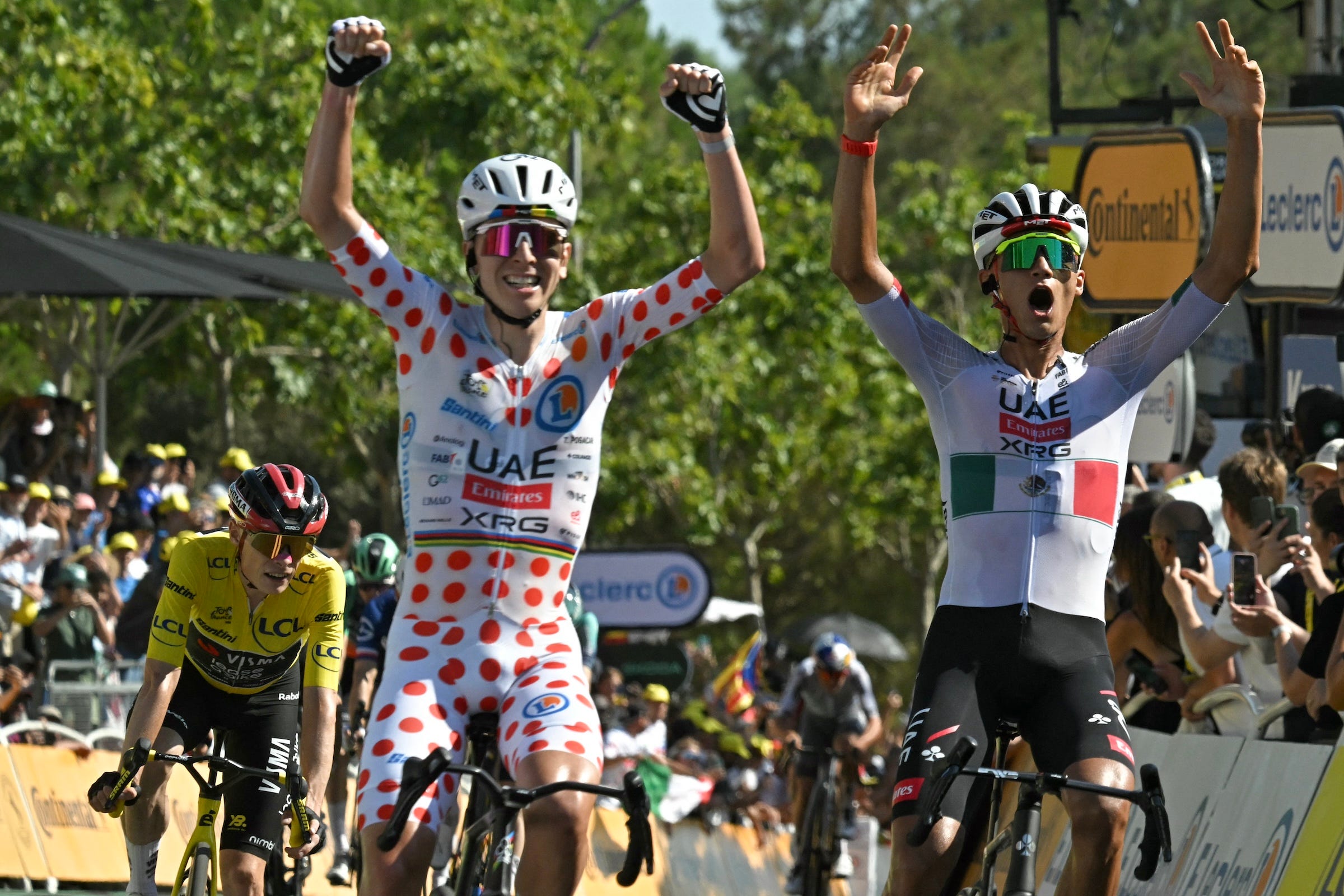
In some ways, these complaints are to be expected, and we shouldn’t try to change things just because some people on the internet are unhappy. Even if Tadej wins a lot, he is net-net a good thing for cycling. Greatness is what sports are about. But as I’ll show below, the whinging has justification. Pro cycling is more predictable than it’s been in 60 years. The same teams are winning more and more, and not just Tadej or UAE: across teams, things have been growing steadily more predictable for 20 years. This seems to be driven in part by changes in team recruitment and in part by how races are raced.
David Lappartient, president of the UCI, has (rightly) recognized this as an issue, and he has led an effort to introduce a budget cap. Teams have shot it down. It would be a mistake for it to go away. In the next post, I’ll cover the proposal by comparing cycling with other pro sports, as well as checking in on something the UCI has already tried to increase competition.
The best teams are winning more than ever
This is true not just of the best team each year, but the 2nd, 3rd, 4th and 5th best teams too: across the board since about 2010, top teams are winning more. Right now they’re winning more than at any point since 1960.
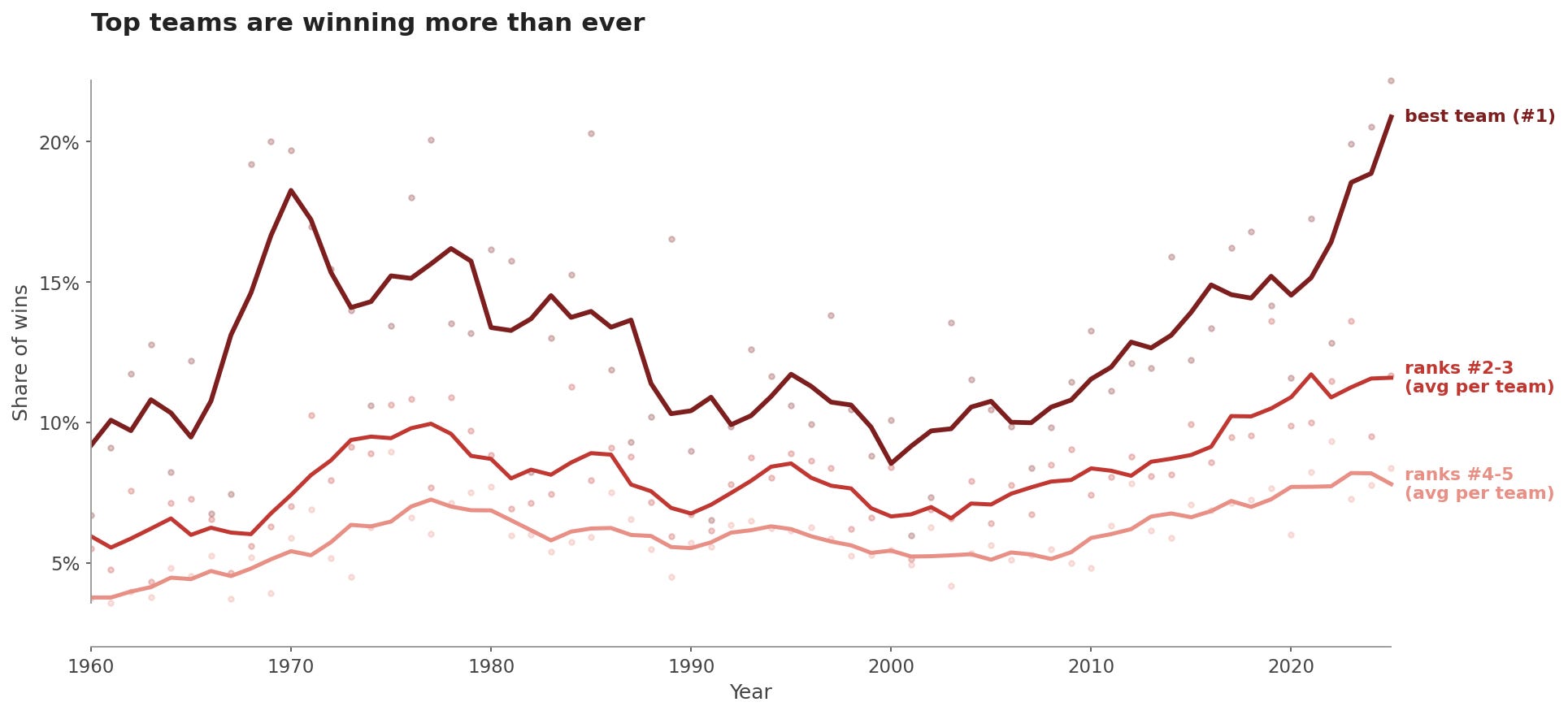
For this graph (and the following graphs) I’m using the top 20 stage races and top 40 one day races each year, to get a relatively stable sample of ~300 win opportunities each year. I’m also including wins that have been invalidated to better compare today’s viewing experience with years in the past.3
If we weight by race importance (using PCS points, Pro Cycling Stats’ version of UCI points, which go back to 1960), the growth since 2010 still exists, but current teams can’t quite compare to the great teams of the 70s. Teams in the Merckx era were smaller and entered fewer races, so they collected fewer wins in total - but the wins they did take were concentrated in the sport’s biggest races, enough to put their importance-weighted share above even today’s teams, just. Whether Merckx’s teams were better or worse than UAE is not really important: in any case, almost anybody watching cycling has never seen a sport so predictable.
We can look at things from the opposite end: at any point in time, look at the last 50 races and count the number of teams with at least one win. Fewer teams have a win in the last 50 races than at any point since the 70s, again with a consistent trend down since 2010.
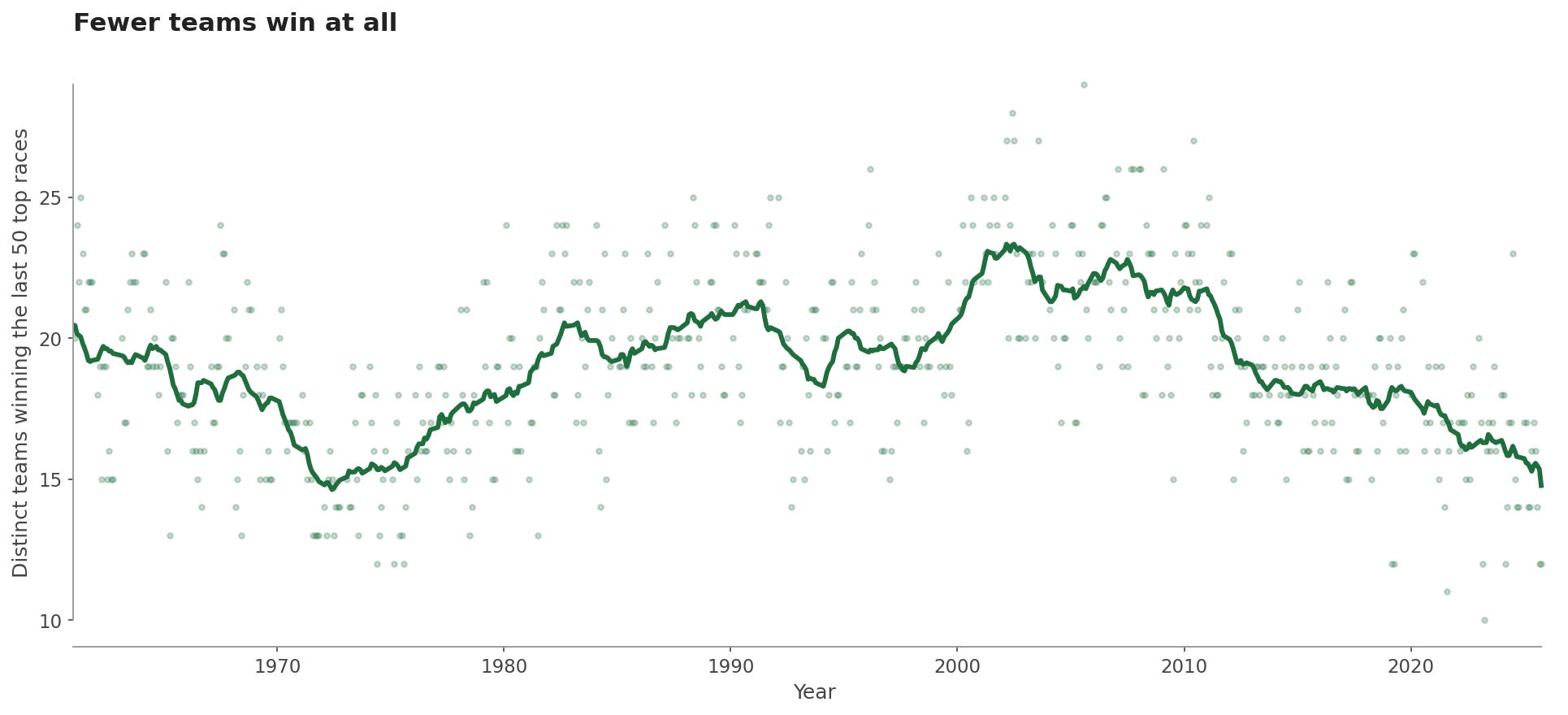
These are not small changes! The top team each year is winning twice as much as they were in 2000, and over the last 50 races4 there are 7 fewer winning teams now than there were in 2004. And this is still true even if you remove each team’s best rider.
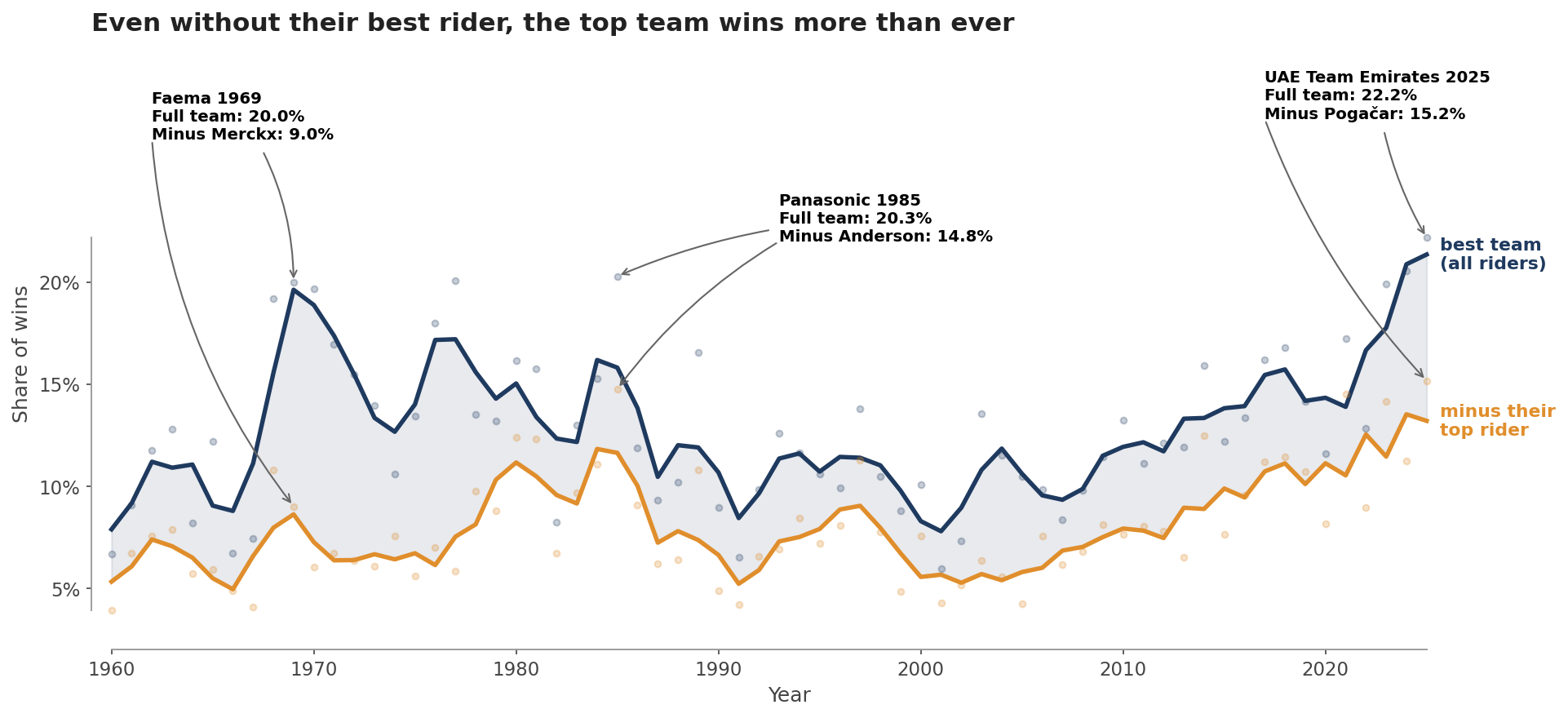
This isn’t driven by Tadej or other superstars, but by a wholesale shift across teams’ rosters. There has clearly been a drop in parity across the peloton, and it’s been going in that direction for 10 or 20 years.
How? Better riders and more predictable races
Top teams have tended to sign better veteran cyclists than worse teams, and gotten more year-on-year improvement out of their young cyclists. And the gap for both is widening
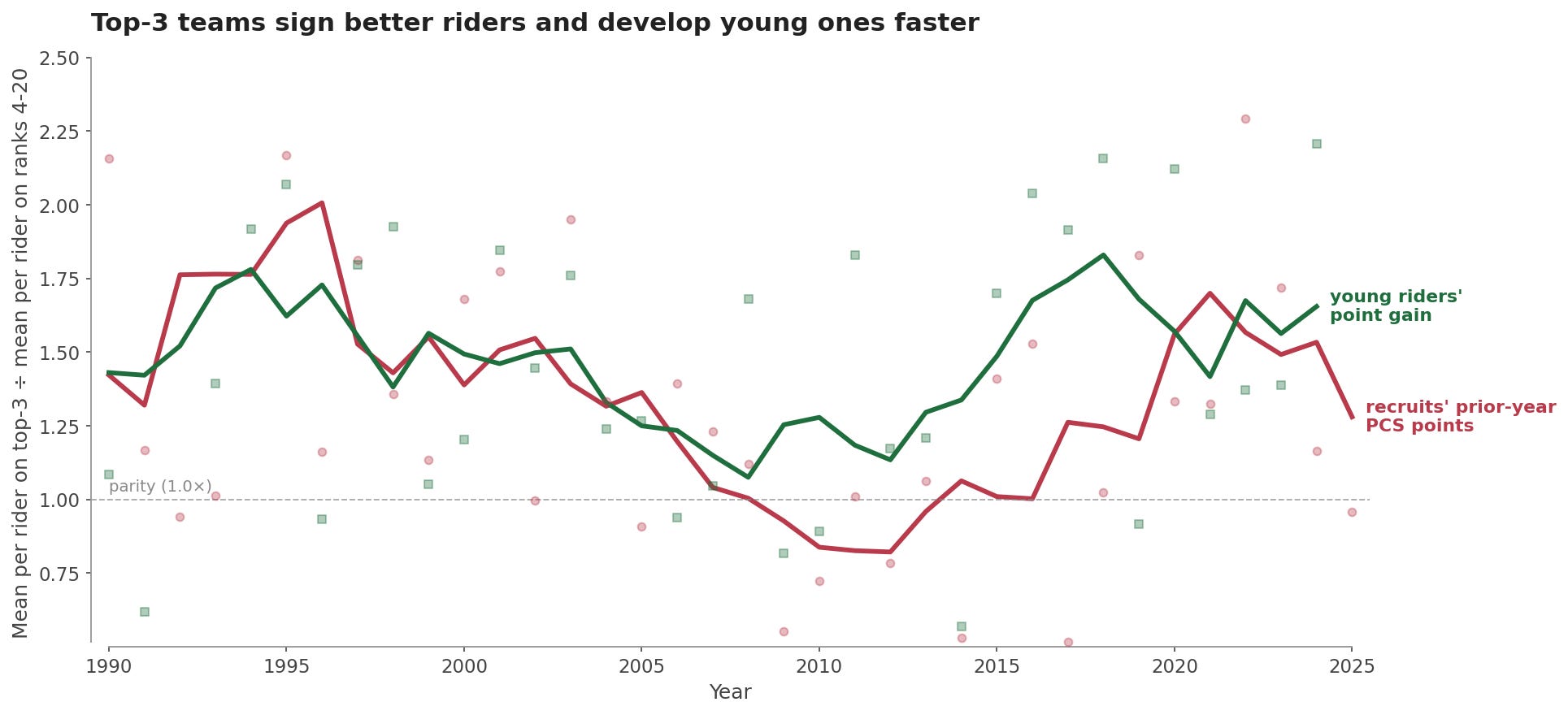
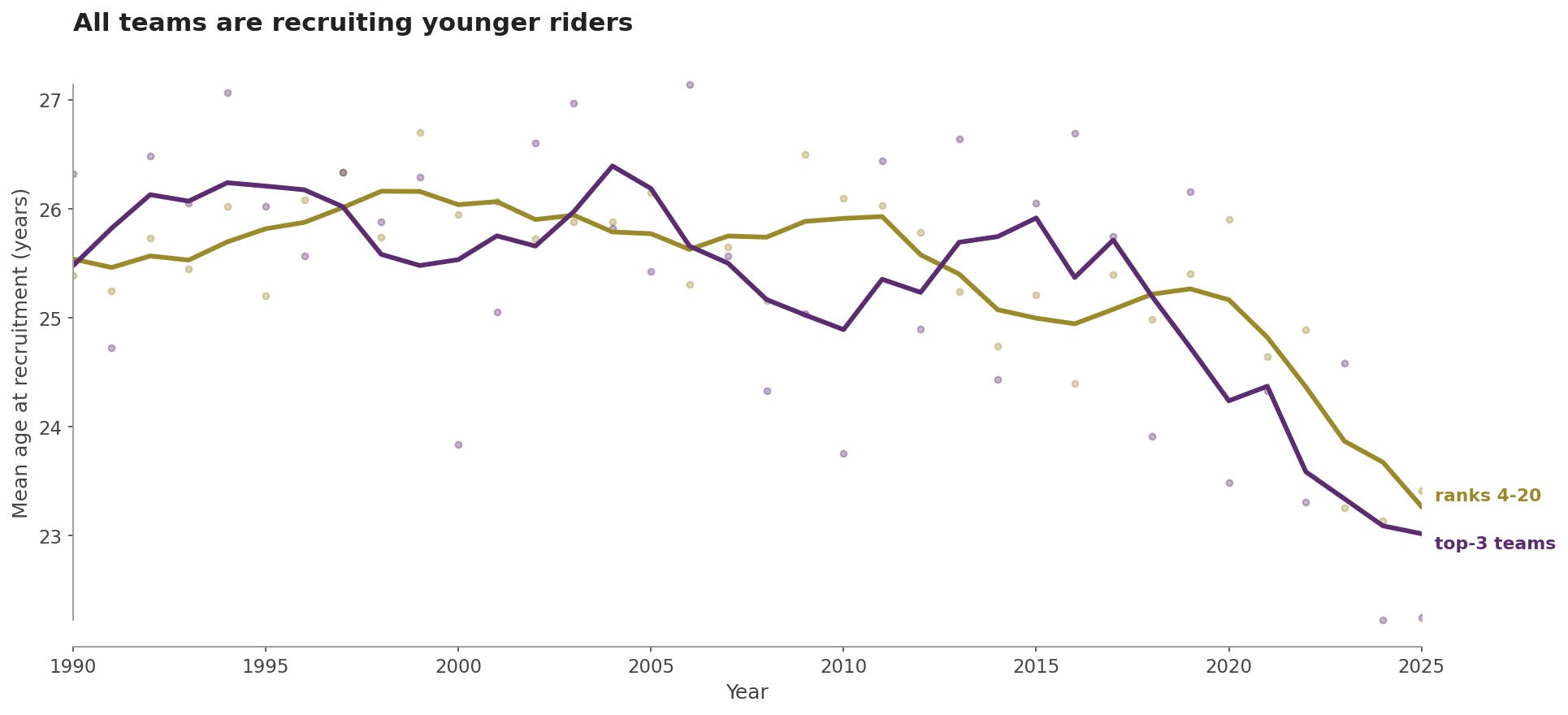
This means that the top 3 teams are picking up riders with 25% more points in the prior year than other teams, and their young riders grow 60% more each year. That is massive! Both gaps were shrinking through the 2000s, and for a few years around 2010 the top-3 teams were actually signing riders with worse credentials than everyone else. But that has reversed in the last 10 years. Compounding this, since 2000 there has been a trend for all teams - top and bottom - to recruit younger riders.
And retention (% of roster who stays on the team next year) is up across the board, and is now nearly even across the top-20 teams: 82% for top-3 teams vs 79% for teams 4-20 overall, and 89% vs 82% for each team’s top-5 point-scorers. It’s up by 10-35 percentage points across the board since 1990 — good riders, young riders, top teams and the rest. High retention benefits strong teams because they have the strong riders.
(One note: I don’t find any evidence that very top riders are moving to strong teams more often. When riders successful in one year move to another team the next year, they are just as likely to move to a top team as to a bottom team - and that has been roughly stable since 1990. Lots of noise gets made about huge contract offers by UAE, but it hasn’t been a real shift in actual signings.)
The above phenomena benefit the best teams: everyone signs younger riders; the best teams get more gains out of them each year, and those gains compound because all teams hold onto riders (so the best teams hold onto the best riders). There is a shift here that ossifies the strongest teams (even more so than before) at the top.
During races, things are similarly tilting towards the strongest teams. Over the last 10 years early breaks have been given less leash, and more wins are coming from solo attacks launched further from the finish. These changes favor the strongest riders (and the strongest teams): fewer chaotic finales and fewer lottery wins from early breaks means less variance in race winners.
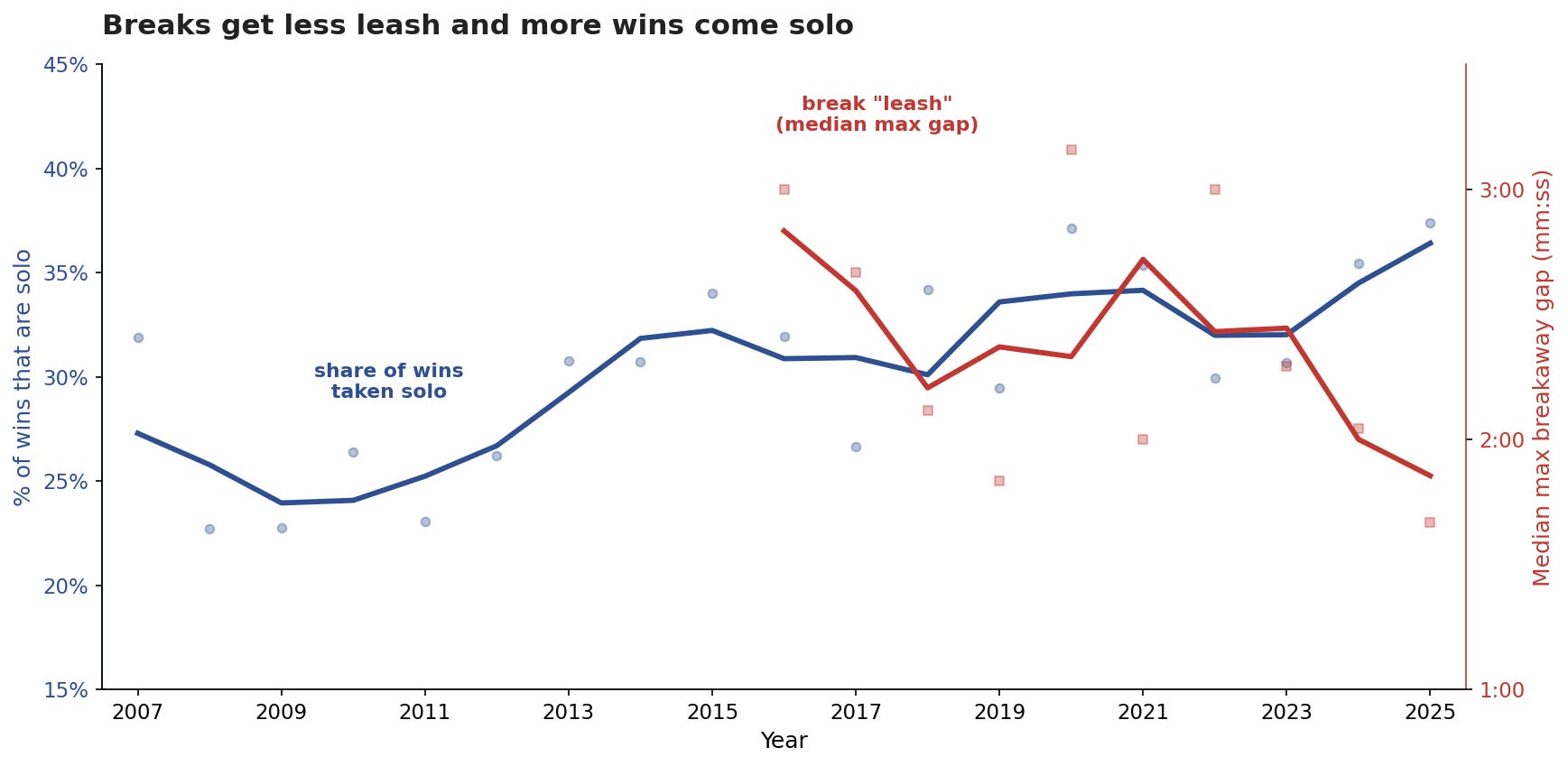
The breakaway gap data was collected from live race timing feeds which are only stable back to 2016.
Teams who are much stronger than their opponents and have the best rider in the race can ride the front all day, keep early breaks from gaining any real advantage, and then have their rider attack and ride away from everybody. It’s exactly what UAE did on the Tourmalet at this year’s Tour: seven riders drilling the front until Pogacar attacked and rode away alone. In the past, that stage might have been won by an early break.
Teams in the top 3 of GC podiums at Grand Tours are also winning more stages in those Grand Tours in the last 5 years than any period since 1990: in the last 4 years, GC podium teams won 30% of grand tour stages, up from 22% between 1998 and 2002. Top teams are so dominant that they don’t need to trade off quite as much between overall results and stage wins.5
Why? Some theories…
What could be happening here? To summarize:
The best teams are winning more; the worst teams are winning less; and this is not driven by a few riders or a few teams. It’s a steady shift over 20 years
Top teams are getting better at developing their young riders and at recruiting strong veterans
All teams are recruiting younger riders in general and all teams are holding onto their riders longer; so the teams that develop better do even better
More races are won from solo breakaways, and early breaks get smaller gaps
I know that this time period aligns with the end of doping (or at least of dopers caught); I know that through this period races have gotten much faster; and in the last 5-10 years, riders have rapidly increased their carb intake, eating more than they ever have before during races and training.
None of these seem like the right theory to me. Maybe we aren’t catching dopers anymore because they’re on some great new drug, but the different top teams across 10 years would have had to be in on it and kept it a secret: seems very unlikely. Maybe riders are more aerodynamic, making it easier for the best riders to stay away from chasers; but then wouldn’t we also see early breakaways stay away more? And maybe riders eating more allows good teams to ride the front all day every day, whittling other teams down and not needing to take days off. This last one seems like the most likely thing to be contributing, but I don’t think it’s the whole story. The smaller teams are carbing up too, and food doesn’t explain the shifts in team recruitment.
There is another theory: that there is a growing spending disparity between the best and worst teams. Unfortunately this is not really testable with data. The team spend data that we have comes from a small number of audits and then basically confidential sources within teams. It’s pretty rough, and it doesn’t have good coverage across teams or back in time. So this is an untested theory, but it would fit the patterns we are seeing above: recruiting better riders, keeping them longer, etc.
One loose theory: the internet has increased the value of ‘global’ advertising, and ‘local’ advertising is now relatively less valuable. In the early 2000s, there were many bad teams, often packed with riders from one area. Even if they didn’t win many races, they were popular with local fans, and that meant that they could find consistent sponsors (usually local flooring businesses, small banks, or brioche makers). There are still French and Spanish teams in the World Tour but I think the local connection has faded a little as small banks became big banks and Youtube let fans follow other, better teams. (Uno-X has notably been bucking this trend, leaning hard into their Scandinavian-ness). If small teams aren’t winning and local fans no longer pay the bills, then why sponsor them when you could sponsor a team that wins constantly? You’ll probably get better pictures for your socials.
Of course this is all just spitballing. Maybe spend disparity has not increased at all. But as I’ll show in the second post in this series, every other large sport has implemented financial rules aiming to protect competitive balance; cycling has implemented none. I’ll look at how the UCI tried and failed to improve balance in 2018, and what a better strategy might look like. We don’t need to know precisely why something is getting worse before we look for a solution.
The Case for Dennis Rodman is my favorite wonky and silly sample of basketball analytics culture
This is not to say there isn’t great race analysis done in pro cycling, but rather that the analysis is done at the race-level, seldom across many races. It seldom uses data. Qualitative analysis is invaluable to the extent that people understand racing well to begin with, but as anybody who has seen Moneyball knows, people can be thinking about things wrong: data lets us check our heuristics.
Success in cycling is very hard to define, and any way you do it has value judgements built in. My method here counts a Tour de France win the same as a win in Dwars door Vlaanderen, which is certainly not accurate, but I’ve chosen it because it allows clean comparison far back in time. It also weights stage wins relatively highly - most wins each year are stage wins.
Really win opportunities, not races: each one day race or stage of a stage race is a win opportunity, as is the end of a stage race when somebody wins GC.
Improved nutrition may also allow riding harder day-after-day. Again allowing the best teams to try to win every stage, and leaving fewer opportunities for everybody else.